

Advantages and benefits
- High manufacturing quality. Achieved through production of pump parts on modern Japanese and European equipment according to European quality standards. Assembly is performed by highly skilled personnel, and every pump undergoes testing on test benches.
- High efficiency
- High performance with smooth and continuous liquid delivery
- No suction or discharge valves, resulting in lower sensitivity to contamination of the pumped fluid and no flow pulsation
- Compact dimensions (lightweight; small footprint; low foundation loads; minimal material usage, ensuring lower cost compared to other pump types)
- Easy start-up and flow regulation
- Easy repair and maintenance (achieved by direct connection of the pump head to the motor shaft and a design with few components. All wear parts are easily replaceable — see assembly drawing and manual on the website)
- High operational reliability and durability
FAQ
A centrifugal pump is a mechanical device that uses a rotating impeller to create flow within the pump casing, thereby increasing fluid pressure; commonly used for pumping liquids in various industries.
Centrifugal pumps operate on the principle of converting the mechanical energy of the rotating impeller into kinetic energy, and then into potential energy to move the fluid through the pump into the discharge pipe.
The main components of a centrifugal pump are the impeller, casing, suction and discharge nozzles, shaft, bearings, and mechanical seals.
Centrifugal pumps can be divided into various types based on their design, such as hygienic pumps, industrial pumps, vertical pumps, magnetic pumps, self-priming pumps, and plastic pumps, each serving specific applications.
Centrifugal pumps are highly efficient, easy to install, require low maintenance, and can operate with higher performance at reasonable pump sizes, making them popular for a wide range of liquid pumping applications.
Not all centrifugal pumps are self-priming. Self-priming centrifugal pumps have a unique design that allows them to draw liquid into the pump without the need for external priming.
Centrifugal pumps are generally not very suitable for handling abrasive fluids, as the impeller and casing can wear out quickly. Specialized pumps, such as slurry pumps, are more appropriate for abrasive fluids. It is also recommended to operate the pump at lower speeds to reduce the negative impact of abrasive fluids on pump components.
When selecting a centrifugal pump, consider factors such as flow rate, head, fluid properties, temperature, and compatibility with the application to ensure optimal performance.
Regular maintenance, including inspection and cleaning, is necessary to ensure the longevity and efficiency of the pump. Follow the manufacturer's recommendations and maintenance schedule.
Centrifugal pumps are generally more suitable for low to medium viscosity fluids. For high-viscosity fluids, positive displacement pumps such as hose or screw pumps are often preferred.
Centrifugal Pumps
Description
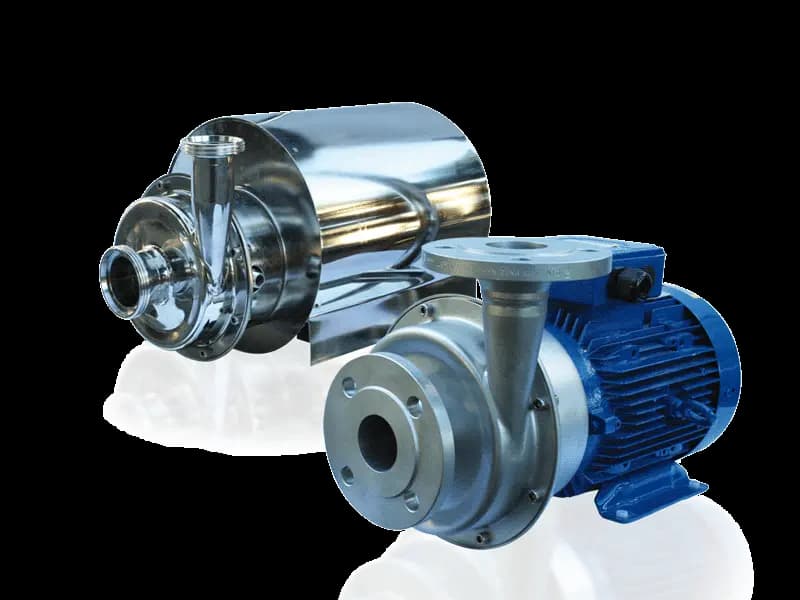
Tapflo centrifugal pumps are among the most versatile pumps available on the market today. Tapflo centrifugal pumps are suitable for a wide range of pumped liquids and find application in many industries: chemical, food, paint, electroplating, and many others.
The Tapflo centrifugal pump portfolio includes:
- general industrial pumps CTI;
- hygienic pumps CTH;
- self-priming pumps CTS;
- magnetic coupling pumps CTM;
- vertical cantilever pumps CTV.
Available wetted-end materials include stainless steel (AISI 316L) and plastics (PP and PVDF).
Brochures & Certificates
Product Brochure #1
Download brochure: Download PDF
Product Brochure #2
Download brochure: Download PDF
Product Brochure #3
Download brochure: Download PDF
Overview Brochure
Download the overview brochure Download PDF